
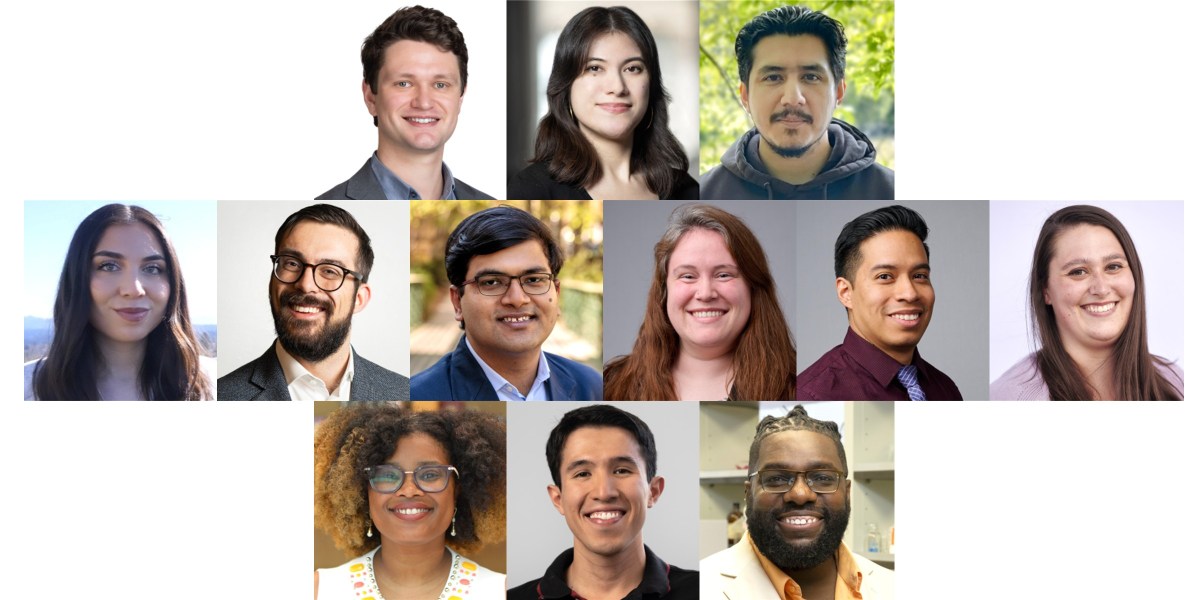
Research Corporation for Science Advancement has selected a new cohort of 12 outstanding postdoctoral scholars in the third year of the RCSA Fellows initiative, a multiyear program to advance faculty excellence in the physical sciences in the United States and Canada by supporting early career researchers as they prepare to apply to, interview for, negotiate, and ultimately thrive as teacher-scholars.
“In a rapidly changing academic ecosystem, early career scientists are seeking and valuing community and structured preparation for the academic job market,” said RCSA President & CEO Eric Isaacs. “This cohort will help shape a more inclusive and resilient professoriate — one that is better prepared to meet the evolving challenges of academic life and keep science vital and innovative.”
The program includes a mock interview at a host institution, structured feedback and guidance throughout the job search process, as well as participation in a network of other Fellows and program advisers at various stages in their careers. As the program has matured, Fellows at various stages of the transition from postdoctoral researcher to faculty member are learning from one another through shared experiences and mentorship.
“This community is becoming a durable source of professional growth, shared wisdom, and collaborative energy,” said RCSA Program Director Eileen Spain, who leads the initiative. “Fellows are forming lasting connections and supporting each other, which we hope will continue long after their formal participation in the program.”
Spain stressed that selection of Fellows is based on more than individual merit. Weighed heavily in the selection process is applicants’ ability and desire to be part of a community, bringing their individual experiences to the program.
“RCSA Fellows care not just about their own advancement but about their peer Fellows as well,” she said.
A hallmark of the program is its mock interviews, which leverage connections among RCSA’s extensive Cottrell Scholar and Scialog networks.
“We had the chance to meet a very promising up‑and‑coming faculty member, and it is a joy to learn about their science,” one 2025 host noted.
Fellows describe the experience as transformative. One participant explained that the process “highlighted some gaps in my knowledge I needed to fill, got me used to the marathon‑style meetings, and the one‑hour seminar was a challenging experience.”
Another Fellow added, “Overall it was an enriching experience. I’m confident that it will help me grow professionally.”
Interest in the program among the RCSA physical sciences community has surged, with Fellows nominations increasing threefold, and the number of campuses offering to host a mock interview up this year.
Fellows have already demonstrated strong early career outcomes. Five members of the first cohort in 2024 have secured faculty appointments and one has taken an industry position. Fellows from the 2025 cohort are securing faculty positions, and continuing or preparing for their faculty job search processes
The third RCSA Fellows Conference – on the theme of “Foundations & Flexibility in An Evolving Academic Ecosystem” – will be held June 3–5 in Tucson, Arizona, bringing together Fellows, facilitators, and advisers to network and help build skills for launching and succeeding in independent academic careers. The conference agenda will include a tailored curriculum for each cohort year around common session themes of career progression planning, communicating your scientific vision, evidence-based teaching and pedagogy, enhancing academic research success, and inclusive mentorship.
Serena Eley, an Assistant Professor of Electrical & Computer Engineering at the University of Washington – as well as a 2022 Cottrell Scholar and Scialog: Quantum Matter and Information Fellow – will give the keynote talk, focusing on the concerns of pre-tenure faculty in today’s STEM landscape, including career goal setting for success.
Facilitators leading sessions at the conference will be: Penny Beuning, Northeastern University; Laura Chomiuk, Michigan State University; David Patrick, Western Washington University; and Keith Hawkins, University of Texas at Austin.
The 2026 RCSA Fellows are:
- Raymond Adkins
Molecular Biophysics and Biochemistry
Yale University - Aida Behmard
Astrophysics
Flatiron Institute - Jorge Cortés
Astronomy & Astrophysics
University of California, Santa Cruz - Akaxia Cruz
Physics
Princeton University - Blaine Fiss
Chemistry
Dalhousie University - Aritra Ghosh
Astronomy
University of Washington - Ashlee McGovern
Physics & Biophysics
University of San Diego - Richard Monge
Physics
City University of New York - Emily Ness
Chemistry
Amherst College - Caprice Phillips
Astronomy & Astrophysics
University of California, Santa Cruz - Hugo Samayoa Oviedo
Chemistry
Texas A&M University - A’Lester Allen
Pharmaceutical Sciences
University of Illinois Chicago
Founded in 1912, Research Corporation for Science Advancement is the nation’s first private foundation solely dedicated to science, supporting early stage, high-potential basic research in the physical sciences (astronomy, chemistry, physics, materials, as well as adjacent fields) at colleges and universities in the United States and Canada. It creates and supports engaged communities of early career researchers through the Cottrell Scholar Program, Scialog, and the RCSA Fellows initiative.