
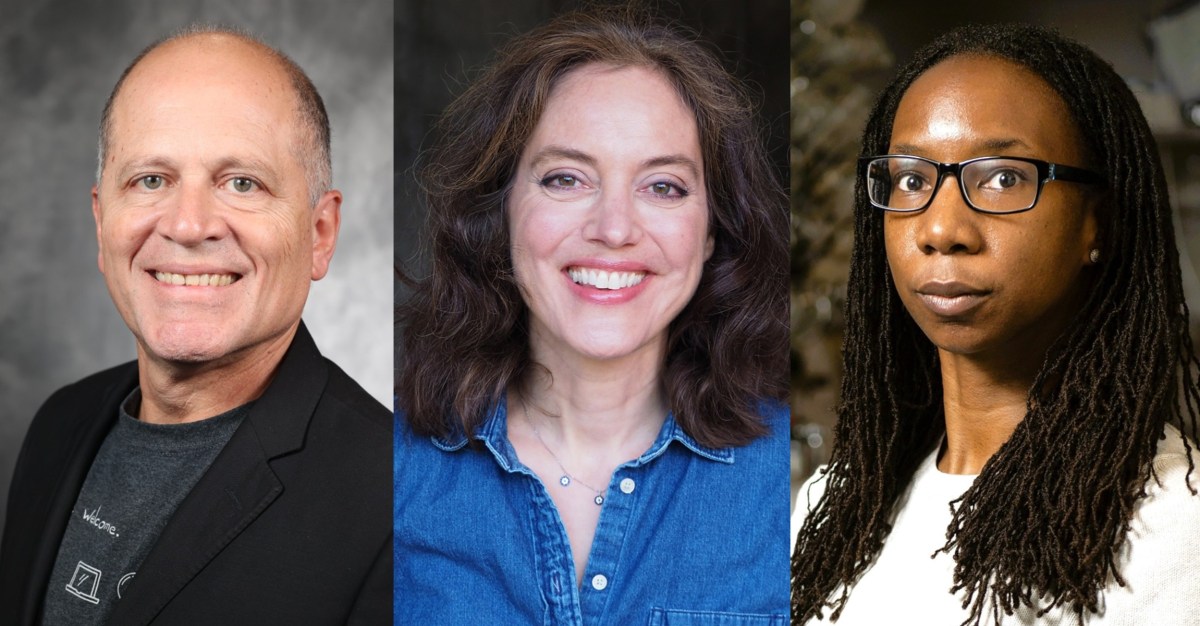
Three senior scientists with exemplary records in research, leadership, and mentoring will join the Cottrell Scholar community as recipients of Research Corporation for Science Advancement’s Robert Holland Jr. Award. The awards, which come with a $5,000 cash prize, honor the late Robert Holland Jr., an engineer and corporate executive who served on RCSA’s Board of Directors.
The 2026 awardees are Jorge Colón, Chemistry, University of Puerto Rico, Río Piedras; Amy Mainzer, Astronomy, University of California, Los Angeles; and Davita Watkins, Chemistry, Ohio State University.
“As experienced researchers and mentors, Holland Awardees bring critical insight that strengthens the Cottrell Scholar community’s continuing efforts to expand opportunities in STEM,” said RCSA President & CEO Eric Isaacs.
Holland Award recipients will attend annual Cottrell Scholar conferences and be eligible to participate in Cottrell Scholar Collaborative projects to promote excellence in science education. They will also be eligible to apply for other awards – including Cottrell IMPACT, SEED, and STAR Awards – that become available to Cottrell Scholars as they advance in their careers.
Holland Award recipients will be introduced and will give presentations at this year’s Cottrell Scholar Conference, which will be held July 8-10 in Tucson.
“In the spirit of Bob Holland’s commitment to elevate students from all backgrounds, this year’s awardees bring not only exceptional scientific achievements and leadership but also a demonstrated dedication to creating learning environments that help more young scientists succeed,” said RCSA Senior Program Director Silvia Ronco.
Jorge Colón, professor of chemistry at the University of Puerto Rico, Río Piedras, is a globally recognized researcher whose career integrates pioneering research in inorganic nanomaterials with inclusive education, mentorship, and community leadership. Colón has mentored hundreds of high school, undergraduate, and graduate researchers, cultivating rigorous training in a safe, personally attentive environment that builds scientific writing, presentation, and professional skills — an approach now propagated by his mentees as “mentor of mentors.” He leads the NSF PREM Center for Interfacial Electrochemistry of Energy Materials (CIE2M) partnership of four institutions in Puerto Rico with CHESS/Cornell synchrotron facility, co-leads the DOE Partnership to Increase Representation in Energy Research in Puerto Rico, which places students in clean-energy internships at the National Laboratory of the Rockies (formerly NREL), and has created durable K12 pipelines through the Caribbean Brigade of the NSF-funded Center for Chemical Innovation on Solar Fuel’s Solar Army, which reached thousands with hands-on climate and solar energy workshops. He brings to the Cottrell Scholar community proven ideas for building research ecosystems that advance science while elevating low-income, first-generation, and historically underrepresented students.
Amy Mainzer, professor of planetary science at the University of California, Los Angeles, is a teacher-scholar whose career unites “big science” research leadership, innovative teaching, and far-reaching public engagement. A leading planetary scientist, she directs NASA’s NearEarth Object (NEO) Surveyor mission — a $1.4B flagship observatory slated to launch in late 2027 to discover, track, and characterize potentially hazardous asteroids and comets — and previously led NEOWISE, advancing planetary defense through space-based infrared discovery and characterization. Her scholarship spans hyperspectral imaging and lidar to map invasive species in Southern California forests, underscoring how spaceborne and airborne remote sensing can safeguard both planetary and terrestrial environments. As chair of the AAS Division of Planetary Sciences and NASA’s Planetary Advisory Committee, she helped facilitate broader participation of students from non-R1 institutions with NASA science. As science advisor, co-executive producer, and on-camera host for 130+ episodes of PBS Kids’ “Ready Jet Go!” and feature films, she has helped make space science accessible to millions of children.
Davita Watkins, associate professor of chemistry at Ohio State University, is a leader who synthesizes research innovation in organic and polymer materials, award-winning teaching, and transformative mentorship to expand opportunity in STEM, which she calls “foundational to scientific advancement.” Her interdisciplinary research program — focused on establishing design guidelines for novel materials with tunable properties through molecular self-assembly — has led to the development of novel organic semiconductors, functional devices, and drug delivery systems, and has trained more than 60 researchers across academic levels, with alumni advancing to national labs, leading universities, and industry. Watkins founded Operation ICB (I Can Be) to immerse rising rural and minority high-school scholars in laboratory research, has built cross-disciplinary women-in-STEM networks, coadvises chapters of the National Organization for the Professional Advancement of Black Chemists and Chemical Engineers (NOBCChE), codirects the Chemistry Bridge Program at OSU, and, previously at the University of Mississippi, helped the institution develop centers to expand training in nano- and biomaterials research.
Founded in 1912, Research Corporation for Science Advancement is the nation’s first private foundation solely dedicated to science, supporting early stage, high-potential basic research in the physical sciences (astronomy, chemistry, physics, materials, as well as adjacent fields) at colleges and universities in the United States and Canada. It creates and supports engaged communities of early career researchers through the Cottrell Scholar Program, Scialog, and the RCSA Fellows initiative.