
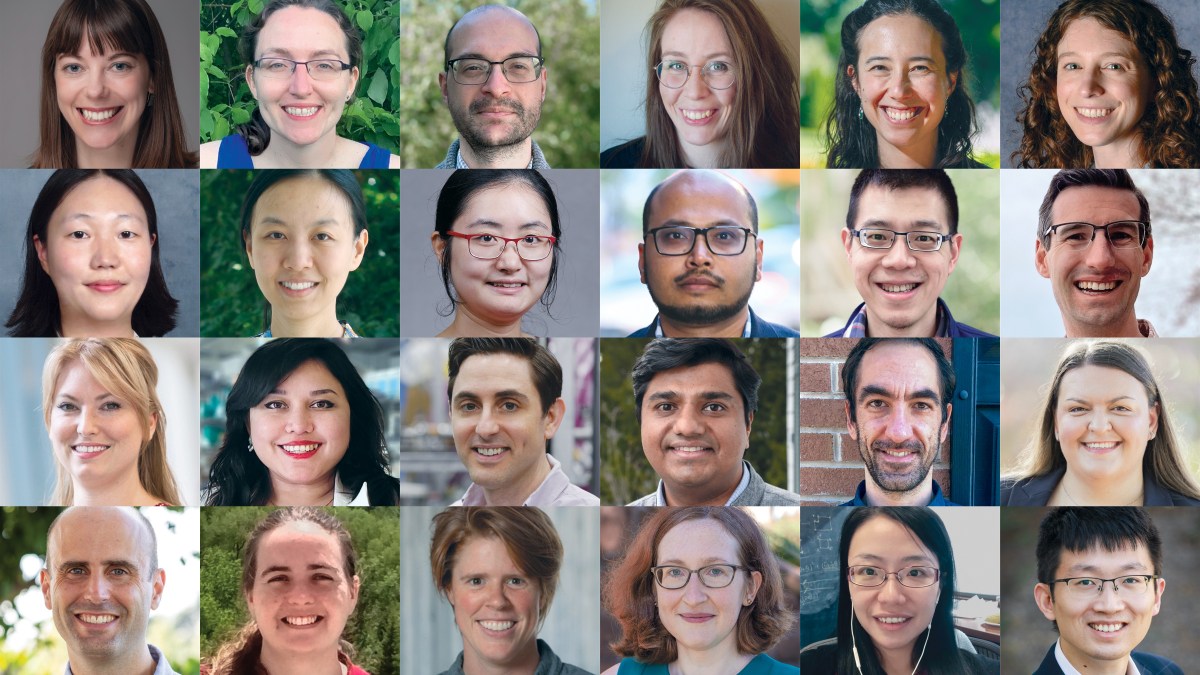
Research Corporation for Science Advancement, America’s first foundation dedicated wholly to science, has named 24 early career scholars in chemistry, physics, and astronomy as recipients of its 2026 Cottrell Scholar Awards. Each awardee receives $120,000.
“This is an exceptional cohort of teacher‑scholars whose innovative work fuels discovery across the physical sciences,” said Eric Isaacs, President & CEO of RCSA. “Their insights and energy will strengthen a 600‑member network of researchers, leaders, and mentors dedicated to pushing the boundaries of knowledge while shaping the future of science and science teaching in the United States and Canada.”
Cottrell Scholars are chosen through a rigorous peer-review process of applications from public and private research universities and primarily undergraduate institutions in the United States and Canada. Their award proposals incorporate both research and science education. Since the program was launched in 1994, awardees have been selected from more than 200 institutions in the U.S. and Canada.
This year’s awardees represent 23 different institutions in 14 different states and Canada, and this is the first Cottrell Scholar for two institutions – Bryn Mawr College and Georgia College & State University. Five of the new Cottrell Scholars have participated as Fellows in RCSA’s Scialog initiatives.
“This class stepped into their faculty roles as institutions were still recovering from the disruptions of the pandemic, and they face an uncertain academic landscape shaped by shifting federal funding and graduate enrollment,” said RCSA Senior Program Director Silvia Ronco. “Becoming part of this vibrant community will give them a space to talk openly about how to succeed, learn from colleagues at every stage of their careers, and contribute their own ideas to strengthening the future of academic science.”
The awards are named for educator, inventor, and science visionary Frederick Gardner Cottrell, who founded Research Corporation for Science Advancement in 1912. “Bet on the youngsters,” Cottrell said. “They are long shots but some of them pay off.”
As their careers advance, Cottrell Scholars become eligible to compete for several additional levels of funding through the other RCSA awards such as Cottrell SEED, STAR, and IMPACT awards. Scholars meet each July at the annual Cottrell Scholar Conference to network, exchange ideas, and develop collaborative projects. This year’s event is scheduled for July 8-10 in Tucson, Arizona.
The Cottrell Scholar community, a multigenerational network of teacher-scholars in the physical sciences, also includes senior researchers who receive RCSA’s Robert Holland Jr. Award, as well as Fulbright-Cottrell Scholars from Germany. All are eligible to participate in conferences and may collaborate on RCSA-funded team projects through the Cottrell Scholars Collaborative.
This year’s Cottrell Scholars are:
Ilsa Cooke
Chemistry
University of British Columbia
Cosmic-Ray Bombardment of Icy Troilite: Clues to the Origins of Organosulfur in Asteroids
Meaghan Deegan
Chemistry
Santa Clara University
Synthesis of Metal-Stabilized Anti-Aromatic Heterocycles from Alkyne-Based Pincer Complexes
William Gilpin
Physics
University of Texas at Austin
Orbit Networks for Interpretable Decomposition of Biological Time Series
Cassandra Hall
Astronomy
University of Georgia
Small Worlds in Tight Spaces: Understanding the Formation and Assembly of the Most Common Exoplanets in the Universe
Anna Ho
Astronomy
Cornell University
Fast Transients: Revealing the Diversity of Relativistic Stellar Explosions
Megan Jackson
Chemistry
University of North Carolina at Chapel Hill
Controlling Chemical Reactivity at Gas-Liquid Interfaces
Na Hyun Jo
Physics
University of Michigan
Developing Uniaxial Stress Techniques for 2D Quantum Materials
Jinghua Li
Physics
Ohio State University
Physics of Light–Matter Interactions in Ultrathin Semiconductors for Chemical Imaging
Zhou Lin
Chemistry
University of Massachusetts Amherst
Understanding Fischer–Tropsch-Type Catalysis in Space: Spectroscopic Analysis Empowered by Generative Artificial Intelligence
Subhasish Mandal
Physics
West Virginia University
Tuning Quantum Matter: A Computational Framework for Vibrational Properties in Correlated Topological Heterostructures
Yao-Yuan Mao
Astronomy
University of Utah
Small but Mighty: Mapping out Low-Mass Galaxies in the Nearby Universe
Arnold Mathijssen
Physics
University of Pennsylvania
Bacterial Active Matter in Self-Regulating Flow Networks
Asja Radja
Physics
Bryn Mawr College
Fluid, Form, and Fluency: Octocoral Fluid-Form Interactions and Improving Math Fluency in the Physics Classroom
Devleena Samanta
Chemistry
University of Texas at Austin
Chemically Programmable Nanoscaffolds to Rewrite Biocatalysis and Adaptive Digital Resources to Deepen Quantitative Reasoning Skills in Analytical Chemistry
Derek Schaeffer
Physics
University of California, Los Angeles
Discovering Fundamentals of Magnetic Reconnection in Mini-Magnetospheres Through AI-Accelerated Experiments
Arnab Sengupta
Chemistry
Georgia College & State University
Structure-Function Relationship for Cap-Independent Cellular mRNA Translation Using Higher-Order Chemical Probing Strategies
Edgar Shaghoulian
Physics
University of California, Santa Cruz
Observers in Quantum Cosmology
Olja Simoska
Chemistry
University of South Carolina
From Pulsed Electrodeposition to Pedagogical Impact: Advancing Nanomaterials Science and Research-Based Learning in Electrochemistry
Daniel Tamayo
Astronomy
Harvey Mudd College
Understanding the Dynamics and Fates of Chaotic Planetary Systems
Jamie Tayar
Astronomy
University of Florida
The Importance of Interactions
Erin Teich
Physics
Wellesley College
Prediction and Control of Mechanical Response in Deformable Jammed Solids
Sarah Wellons
Astronomy
Wesleyan University
An Ounce of Preventative Feedback, a Pound of CURE: Modeling the Physics of Supermassive Black Holes in Milky-Way-Mass Galaxies
Yizhi You
Physics
Northeastern University
A Route Map to Open Quantum Systems and Mixed States: Insights from Duality
Tianyu Zhu
Chemistry
Yale University
Elucidating the Design Space of Photoactive Molecules Using Quantum-Chemistry-Informed Machine Learning
Research Corporation for Science Advancement is a private foundation that since its founding in 1912 has supported early stage, high-potential basic research in the physical sciences (astronomy, chemistry, physics, and related fields) at colleges and universities in the United States and Canada. Its focus is to advance fundamental scientific discovery for the benefit of society by providing catalytic funding for research, and by sponsoring conferences to spark interdisciplinary collaboration and encourage innovation in science teaching. It creates and supports engaged communities of early career researchers through three core programs: the Cottrell Scholar Program, Scialog, and the RCSA Fellows initiative.