
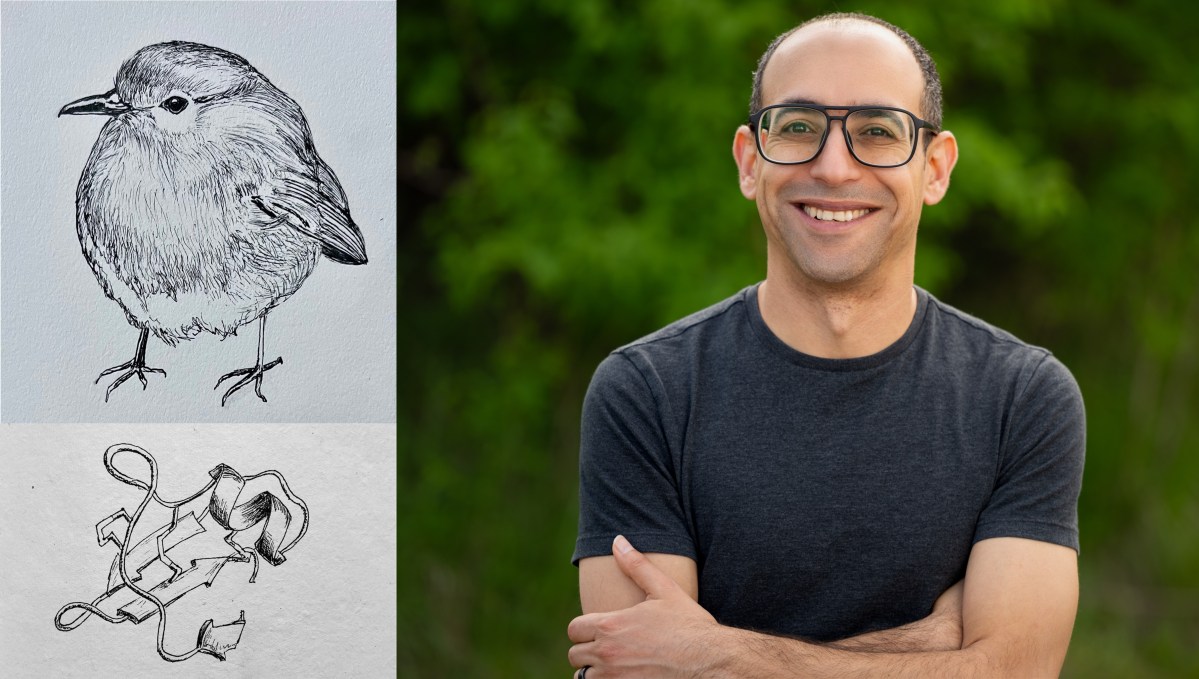
Cottrell Scholar 2019 Shahir S. Rizk, Associate Professor of Biochemistry at Indiana University South Bend, is an advocate for better science communication, coauthor of a new book, and cohost of a science podcast. He says his involvement in the Cottrell Scholar community has encouraged him to build his skills and fueled his interest in helping his students and colleagues communicate the joys and facts of science more effectively.
“This community is really passionate about science communication, even though there’s no reward for it,” he said. “This is not going to be part of anybody’s tenure or part of their service portfolio, but it’s a topic that comes up again and again. Their interest is inspiring.”
Rizk said the Cottrell Scholar community was exceptionally encouraging as the book took shape.
“All the Cottrell Scholars I talked to about the idea of writing a book said, “Wow, that sounds ambitious, but you should definitely do it, which is not the same reaction I’ve received from other communities,” he said.
“Cottrell Scholars empower each other to try well-thought-out, crazy ideas,” he said. “The book simply wouldn’t have happened without this support.”
The new book, The Color of North, is coauthored and co-illustrated with Maggie Fink, now an Adjunct Professor at Indiana University South Bend and a bacterial geneticist. Published in May by Harvard University Press, the book weaves together stories, memories of food and family, art and science to illuminate the ways proteins shape organisms and ecosystems on Earth, and explores the potential of advances in protein engineering to heal the environment and cure disease.
“Proteins are naturally amazing and beautiful, but they’re also adaptable and engineerable,” Rizk said. “What we can do as scientists is rearrange the pieces to create new functions that nature has never seen before, like the ability to digest plastic or capture carbon, or detect environmental pollutants or things in your blood that are signs of inflammation or disease.”
He said good science communication is less about imparting a series of facts than it is about “fostering fascination.”
As an example, he cited David Attenborough’s Planet Earth broadcasts, which he loves. “I can’t remember a single fact that I learned about the largest flock of birds in North America, but it was majestic when I saw it, and it triggered in me a different sort of value than a fact or a number. The value I’m left with is an appreciation for our natural world, an appreciation for diversity, an appreciation for life, and an appreciation for the efforts that need to go into conservation.”
This is what Rizk and Fink hoped to do with their book.
“There’s a lot of information in it, but I’m hoping that people come out with an appreciation for the science around them,” he said. “They can say, ‘yes, there is bacteria that can chew up plastic, can you believe it?‘ or they’ll get a new understanding of evolution or of how certain things were discovered, even if they can’t retell exactly what it is.”
Rizk and Fink call the book “an outpouring of love, a tribute to the beauty we witness and the inspiration we feel every day when we step into our labs.”
The book also includes Rizk and Fink’s hand-drawn illustrations showcasing a variety of protein structures and how these shapes support the functions that sustain life. It’s a “reminder of how art often enriches our understanding of science,” they say.
Alongside each illustration is that protein structure’s unique ID in the Protein Data Bank, a repository of all known protein structures. Readers can look up those IDs to examine 3D illustrations of proteins and learn more about them.
In addition to the book, Rizk and Fink have been creating larger-scale art installations and sculpture on science themes and launched a podcast, Rust Belt Science, sponsored by Indiana University South Bend. (It’s on Spotify and Apple music.)
Now beginning its second season, the podcast is friendly and conversational, with Shahir and Fink discussing a variety of topics they find interesting, including conspiracy theories, imposter syndrome, retractions in science, and how funding works in research. Other episodes feature guest scientists talking about their own fields of study.
“It’s a place of joy in learning,” Rizk said. “Hopefully it comes across to our audiences that even though Maggie and I are scientists, we are just as ignorant as everyone else about other fields. I’m like a little kid again, asking how things work. We don’t play dumb, we just want to know what our guests are doing.”
Rizk says he knows a lot more about science communication research now than he did when he began incorporating the subject into his classes as part of his original Cottrell Scholar award in 2019.
He said the educational part of hisproposal aimed tointegrate a variety of “real world” components, including the reality of science careers, questions regarding patents and drug pricing, and the rise of misinformation, into the discussion sessions of his undergraduate biochemistry course.
Discussions of their own struggles battling misinformation among their families and friends led Rizk and his students to want to do better to bridge those communications gaps. They all wanted to explore: “How can I relate these difficult things that I spent years studying to people in my community who know very little about science?”
Then, 2020 happened. During the pandemic, misinformation and the study of misinformation became a mainstream topic, presenting Rizk and his students with an abundance of articles and opportunities to read and discuss the science of misinformation and how it spreads.
To augment those discussions, Rizk came up with an exercise for his classes: Find someone in your community with whom you disagree and start a conversation. Resist the temptation to talk about that topic, just ask questions, find out who they are as a person, and most importantly, be kind. Afterward, students write up their experience and discuss it in class.
“It was a very educational exercise, because we learned about our own insecurities,” Rizk said. “It was very difficult for our students to avoid talking about science. But this is how you grow — when you realize the thing you’re passionate about can be really frustrating.”
Year after year, Shahir says, “students overwhelmingly love these discussions.”
Cottrell Scholars do too, says Rizk, evidenced by the fact that cultivating a broader appreciation of science has been a recurring theme throughout multiple conferences and collaborations he has joined.
After Rizk attended his first Cottrell Scholar Conference in 2019 (on the theme of Communicating Science) he also took part in the first science communication workshop given by a 2018 team, Cottrell Scholars Collaborative for a Science Communication Enabled Community, led by CS Scott Shaw, University of Iowa.
Rizk was hooked on the subject, and after the pandemic and a few fits and starts, Rizk volunteered to help get a follow-up workshop back on track. At the project’s second workshop in July 2025, he and Fink presented a session on communicating in a world of misinformation and societal division. They shared their experiences using personal stories and art to open doors to communication.
“It was very important to me that this workshop happened again, because of the impact that I saw it having on the community,” he said.
“As faculty, and as scientists, we’re talking to people all the time — to community and family members, to administrators and politicians,” he said. “Building personal connections through stories helps break down barriers, giving more people access to information that is essentially behind a paywall in academia. It humanizes the science and humanizes the scientist.”
Over the years, Rizk has also participated in several Cottrell Scholars Collaborative projects, including being among the coauthors of the RCSA-published book, Inclusivity in Introductory STEM Courses: A Guide to Improving Student (and Instructor!) Mindsets.
Rizk’s chapter, “From Lectures to Conversations: Increasing the Sense of Belonging in STEM Courses Through Active Learning Interventions,” details the discussion sessions he uses in his classes to help better prepare his students for careers in graduate/professional schools or in industrial settings, and to train them to form well-composed arguments while being open-minded to opposing views.
Rizk is also a member of a new 2025 Cottrell Scholars Collaborative project led by Aurora Pribram-Jones, University of California, Merced. Connecting Science and People through Storytelling: A CS Writing Community to Develop, Preserve, and Broadcast Scientist Narratives, aims to empower Cottrell Scholars to craft compelling, human-centered narratives to make scientific communication more engaging, more inclusive, and more trusted by the public.
As part of the project, Rizk plans to use his experience publishing the book to connect Cottrell Scholars to editors, agents, and others in the publishing world through a series of informational sessions intended to inform their writing.
Rizk continues to challenge himself as a science communicator, seeking out new opportunities to talk about science or to be interviewed by local media when science topics are in the news. He relishes the chance to try the approach he has taught his students to listen, be kind, and communicate with people with other views.
“Ever since I’ve been a Cottrell Scholar, there have been two annual conferences (2019 and 2024) on the theme of science communication, plus many workshops and other collaborative projects on communication, and I suspect there will be more because it’s so important to us,” he said.
The reaction to the book has been so positive, Rizk is encouraging other Cottrell Scholars to write their own stories to make science approachable.
“I realize that not all scientists can draw,” he said. “Some of us can write poetry, some of us can compose songs, some of us can write plays and musicals, and although there is this myth that somehow science and art are separate, they are very much connected.”
“Don’t be afraid of using whatever gift you have,” he said.