
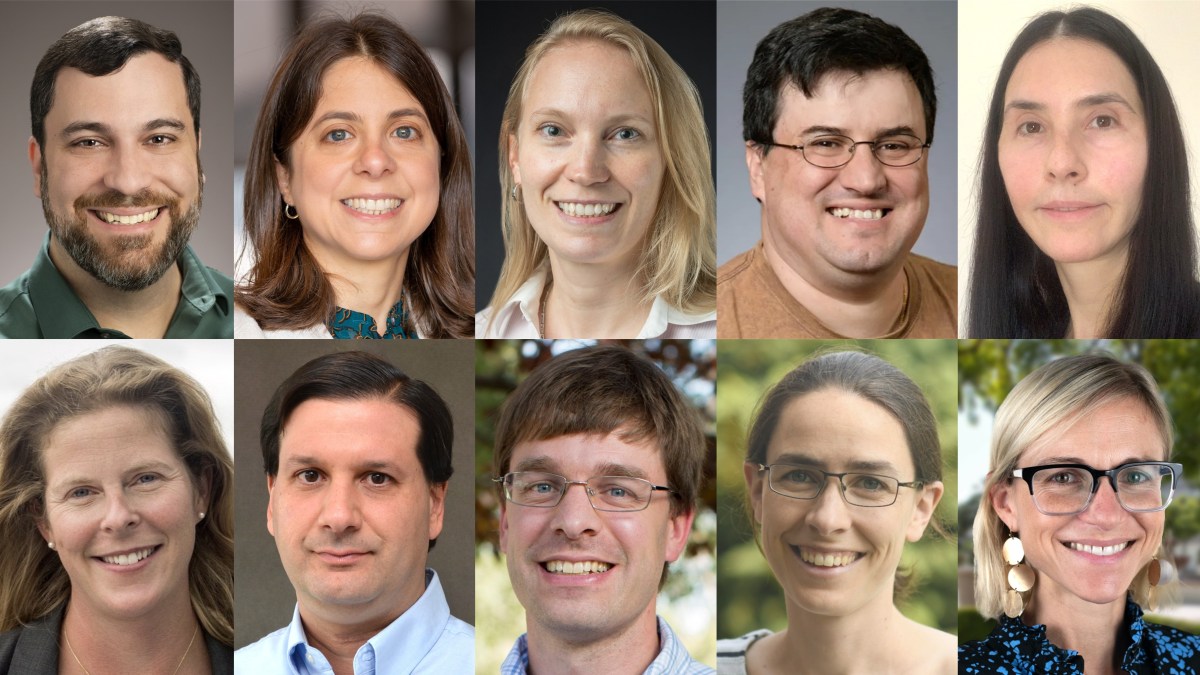
Research Corporation for Science Advancement has made $600,000 total in awards to ten Cottrell Scholars to advance high-impact research activities through its Cottrell SEED (Singular Exceptional Endeavors of Discovery) Awards for 2025.
The competitive awards of $60,000 each, open to Cottrell Scholars and Robert Holland Jr. Award recipients, are in two categories: New Research Directions (for innovative research projects with potential to lead to a transformative line of inquiry) and Exceptional Opportunities (to advance existing research projects at primarily undergraduate institutions to higher levels of innovation and impact.)
This year, astronomy and physics proposals were accepted. Chemistry proposals will be accepted for the 2026 awards.
“This year’s awardees are exploring the fundamental physics of materials while shedding light on the universe itself,” said RCSA Senior Program Director Silvia Ronco. “From quantum mechanics, active matter, and novel glasses to work in astronomy, astrophysics, cosmology, and the crossroads of ultra-cold atom physics and dark matter, their research is pushing the boundaries of science.”
Since 1994, the Cottrell Scholar program has honored and helped to develop outstanding teacher-scholars who are recognized by their scientific communities for the quality and innovation of their research programs and their potential for academic leadership. The active, multigenerational community of nearly 600 academic scientists also includes recipients of RCSA’s Robert Holland Jr. Award, senior scientists recognized for excellence in research, teaching, and mentorship.
The SEED Award is among a suite of Cottrell Plus Awards offered to support members of the Cottrell Scholar community at various stages throughout their careers.
2025 SEED AWARDS FOR NEW RESEARCH DIRECTIONS
Rafael Fernandes, CS 2016
University of Illinois at Urbana-Champaign
Unconventional Magnetism in Strongly Interacting Quantum Materials
Mariangela Lisanti, CS 2017
Princeton University
Galaxy Formation Beyond Cold Dark Matter
Stella Offner, CS 2018
University of Texas at Austin
Predicting Star Formation: Past and Future
Eduardo Rozo, CS 2018
University of Arizona
Measuring H0 Using the Infall Profile of Galaxy Clusters
Lea Santos, CS 2009
University of Connecticut
Critical Quantum Sensing with Driven Superconducting Circuits
Abigail Vieregg, CS 2018
University of Chicago
Probing the Cosmological Dark Ages: Site Characterization and Radio Receiver Development
2025 SEED AWARDS FOR EXCEPTIONAL OPPORTUNITIES
Mario Affatigato, CS 1996
Coe College
Pushing to Boundaries of the World’s Most Common Glassformer: A Fragile-to-Strong Transition of Silica Glass
Charlie Doret, CS 2017
Williams College
Molecular Isotope Shift Spectroscopy in CaH+
Meredith Hughes, CS 2018
Wesleyan University
Gas in Debris Disks as a Tracer of Stellar Astrophysics
Rae Robertson-Anderson, CS 2010
University of San Diego
Harnessing Circadian Clocks to Control Active Matter
Research Corporation for Science Advancement is a private foundation that funds basic research in the physical sciences (astronomy, chemistry, physics, and related fields) at colleges and universities in the United States and Canada.