1920
Andrew Ellicot Douglass was born in Vermont in 1867 and graduated from Trinity College in Connecticut. After graduation, he worked at the Harvard Observatory, and was chief assistant on Harvard’s 1891 Boyden expedition to Arequipa, Peru.
Upon his return from Peru, Douglass met Percival Lowell in Boston. Lowell planned to build an observatory in Arizona and hired Douglass to scout the territory for a good location. Douglass eventually selected a spot on a mesa outside of Flagstaff, where he supervised construction of a dome to house a telescope that he and Percival Lowell would use to observe Mars.
Douglass stayed at Lowell Observatory for seven years serving as Lowell’s chief assistant. Douglass collected data about Mars which Lowell used to support his theories about the existence of an intelligent, canal-building Martian civilization. In 1901, after Douglass and Lowell disagreed about Lowell’s selective use of data to prove his theories, Douglass was fired.
Douglass remained in Flagstaff until 1906, teaching at the Northern Arizona Normal School (now Northern Arizona University). He also became a probate judge (now called a Justice of the Peace) in 1902.
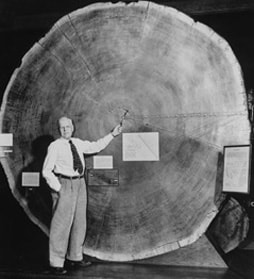
During his time in Flagstaff, Douglass developed a theory of using tree rings as a record of previous solar cycles. In 1906, he relocated to Tucson to teach at University of Arizona where he developed the science of dendrochronology, using tree rings to determine the age of a particular piece of wood. In 1929, he was able to establish an unbroken sequence of yellow pine tree rings that made it possible to conclusively date ancient Native American structures. In 1930, Douglass would receive the Research Corporation Award.
Douglass remained active in astronomy during his time at the University of Arizona. In 1916, he met Henry and Lavinia Steward, who were interested in astronomy. When Mr. Steward died, Mrs. Steward donated $60,000 to University of Arizona to build an observatory. Steward Observatory was completed in 1923 with a 36-inch reflecting telescope. The telescope was eventually moved to Kitt Peak, where it remains in use. Douglass directed the Observatory until his retirement in 1937.
Douglass died in 1962 at the age of 94.