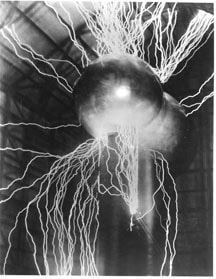
1929
Robert Jemison Van de Graaff was born in Alabama and studied mechanical engineering at University of Alabama. He worked for the Alabama Power Company for a year before moving to Paris to study at the Sorbonne where he attended lectures by Marie Curie on radiation. In 1928, he received a Ph.D. in physics at Oxford University.
By 1929, Van de Graaff was back in the United States, working with Karl Compton at Princeton where he constructed the first working model of the Van de Graaff generator, a device that produces high voltages. Van de Graaff moved to MIT in 1931 (as did Compton, who was president of MIT from 1930 until 1948, and served on RC’s Board of Directors from 1933 to 1953) where Research Corporation supported his work on the belt-charged electrostatic high-voltage generator with annual grants from 1931 until 1941. During those years, Van de Graaff refined and enlarged his invention to obtain precisely controllable acceleration of charged nuclear particles and electrons.
In his 1932 Report on Research, Van de Graaff noted his thanks to RC: “This assistance has consisted not alone in the grant of funds, but also in the very generous and helpful donation of time by officers and employees of the Research Corporation, who prepared the engineering drawings, secured the bids, let the contracts, and contributed many valuable ideas to the design.”
Van de Graaff directed MIT’s high voltage radiographic project during World War II and co-founded the High Voltage Engineering Corporation after the war. His work paved the way for many subsequent developments in nuclear and particle physics.